My First Week on HF
How Did I End Up Here?
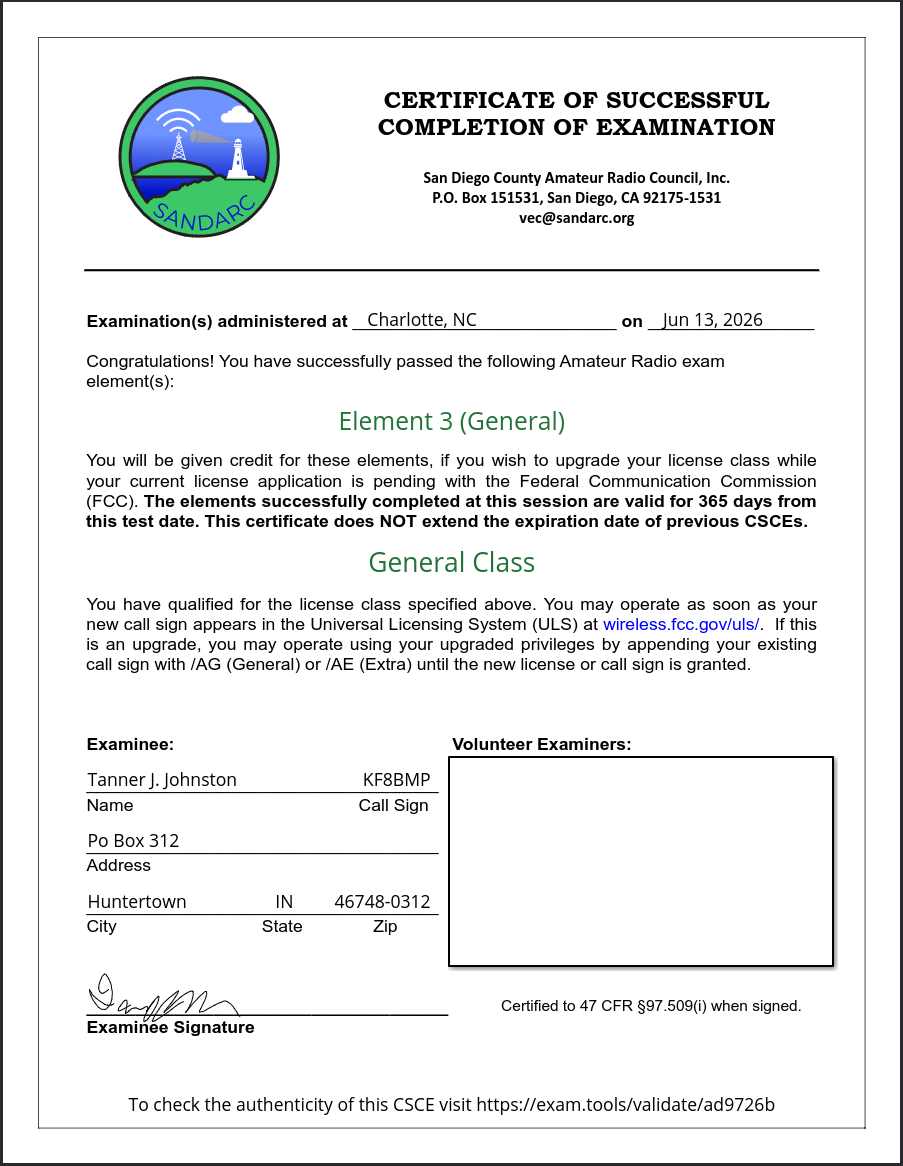
Back in June, I passed the General class amateur radio license exam at Southeast Linuxfest in Charlotte, where I first got my license two years ago. I had no intention of sitting for the exam since I’d done basically nothing with my Technician privileges. However, a spur of the moment decision on the Tuesday before the conference changed things.
Over the next few days, I spent an unhealthy amount of time on HamStudy after work, and come Saturday, I scored 34/35 on the General and a 24/50 on a blind attempt at the Amateur Extra.
Station Analysis Paralysis
Having privileges to operate on the HF bands wouldn’t do me much good without a rig, so I started evaluating my options while my application for a vanity callsign (K8TJJ) was being processed.
The Radio
I wanted something that would work well both at home and in the field, i.e. on a Parks on the Air (POTA) activation. There were quite a few options I considered here, namely the Icom IC-7100, IC-7300, and IC-7300 Mk2 as well as the Yaesu FT-891 and FT-710. While I had also considered a few lower-priced QRP radios such as the QMX and QMX+ from QRPLabs and the Pebble HF from The Ham Radio Duo, I decided that a 100 watt radio would be the best place to start.
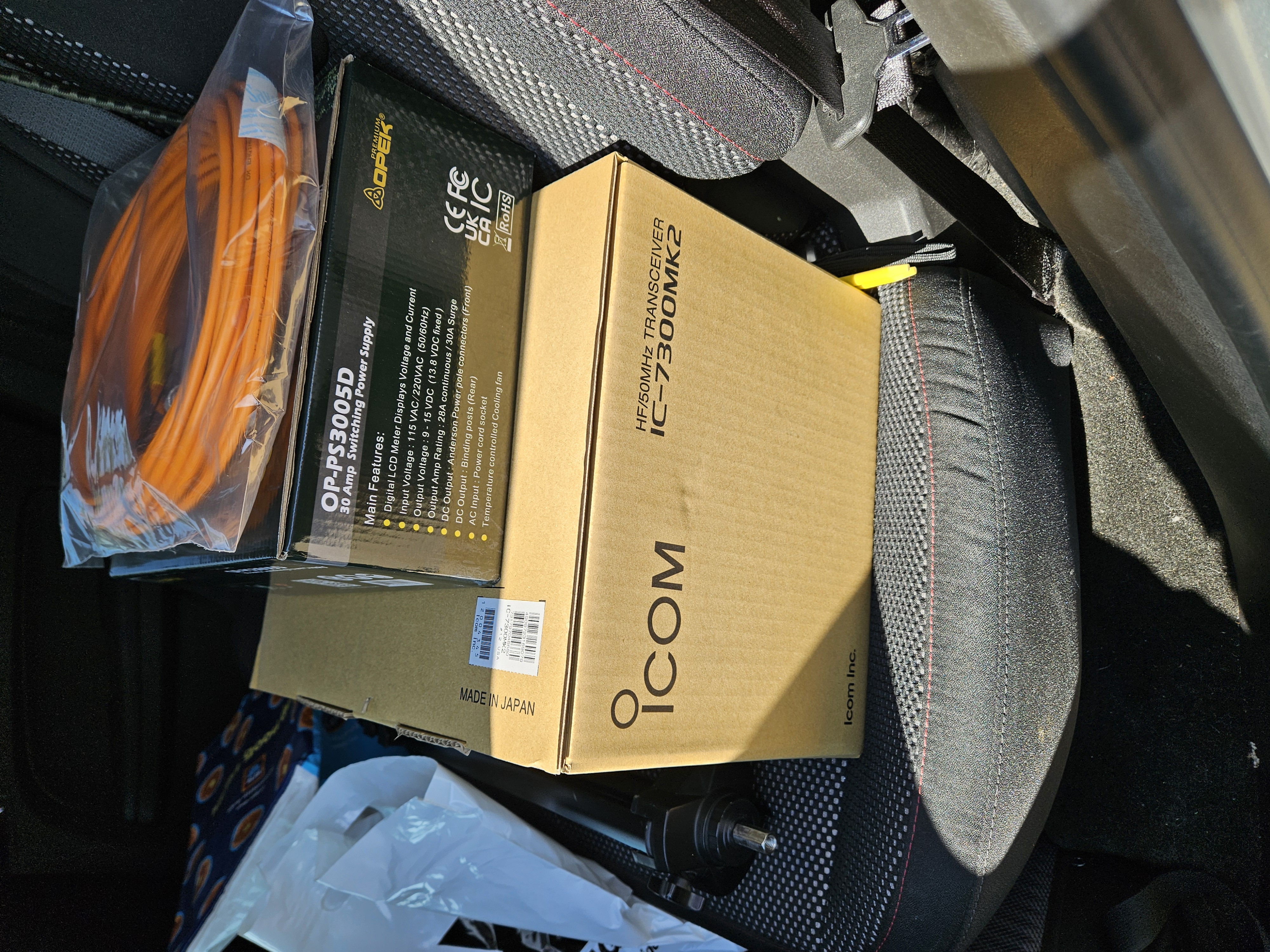
I could’ve purchased a pre-owned radio, but I ultimately picked the IC-7300 Mk2 since its new features compared to the original 7300 were ones that I found valuable. Considering two friends of mine in the Van Wert club (including a hardcore Yaesu fanboy) also bought 7300 Mk2s that same week, I’d say I made a good choice.
The Antenna
This was always going to be my limiting factor. At the time of writing, I live in an apartment and don’t have the ability to put up a permanent antenna, so I had to think like a portable operator. While I have trees off my back patio, they’re too close and too short to be of use for something like an end-fed halfwave. Thus, the most feasible option for me to get on the air from home was a vertical antenna.
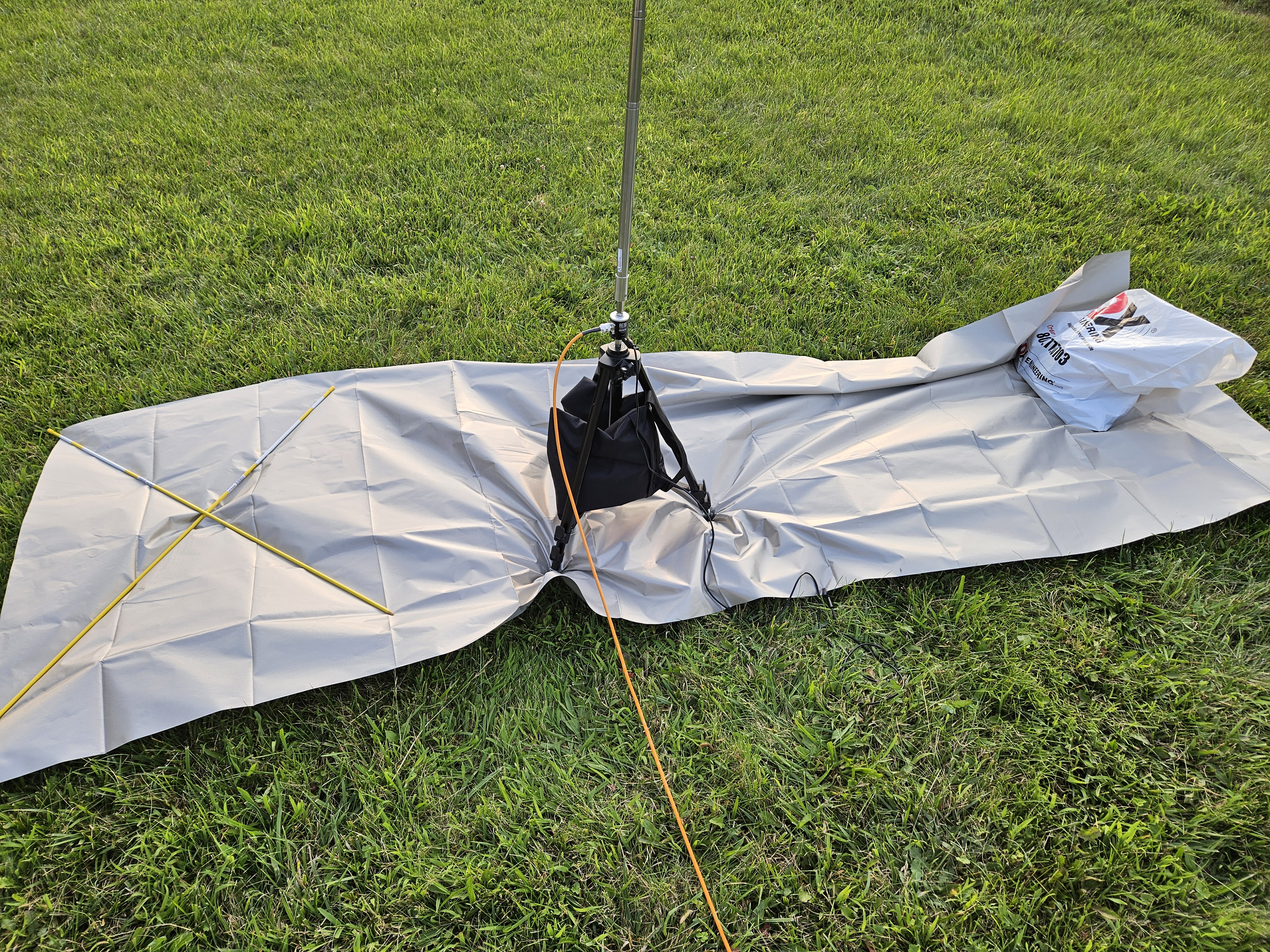
Since I didn’t want to be limited to using a vertical, I decided to buy into the REZ Antennas ecosystem with their Scout XF feedpoint. It allows me the flexibility to run a telescopic vertical, wire or rigid dipole, Rybakov, or delta loop configuration. In addition to the antenna itself, I also purchased a REZ Antennas 4017 40 meter loading coil to expand my frequency range (I’ll talk more about 40 meters later).
For the ground plane, I took two approaches since I could do both of them reasonably inexpensively; linked elevated radials for use in the POTA Performer system and a 118 inch by 43 inch piece of Faraday cloth. Unfortunately, both of these gave me some issues in my first few operations.
Power and Miscellanea
With portable operation being something that I wanted to do, I made configuration and purchasing decisions with that in mind. Originally, I was only planning on buying a 30Ah LiFePO4 battery and using it both at home and in the field, but a quick check of the contest calendar changed my approach. Since the August edition of the North American QSO Party SSB contest was the week after I was going to buy everything, I added an Opek power supply to my order too. Powerpoles are the gold standard for portable power connection in the ham radio scene, so I bought a few sets of those as well as some lengths of various wire and a thread adapter to use with my camera tripod from McMaster-Carr.
Grandma’s House on the Air
This part was easier said than done. The first week I had my radio was mostly a washout in my childhood hometown of Princeton, West Virginia. I only had a few hours of decent weather on Thursday evening (August 13) to test my setup ahead of the contest on Saturday. Unfortunately, this is where I ran into my radial issues.
Two is One and One is None
Initially, I wanted to test my POTA Performer radials, which I’d made out of 18 AWG vehicle wire. After connecting both sets of radials to my feedpoint, I wasn’t able to get my driveway markers into the ground. To add insult to injury, one of my banana plug connections failed due to a poor solder joint (my fault). Since I didn’t have my Pinecil with me, I couldn’t repair the connection and had to pivot to the faraday cloth. Due to the negative experience I had with the setup, I’ll be re-doing the radials with silicone wire and Powerpoles instead of Harbor Freight quick-disconnects in the near future.
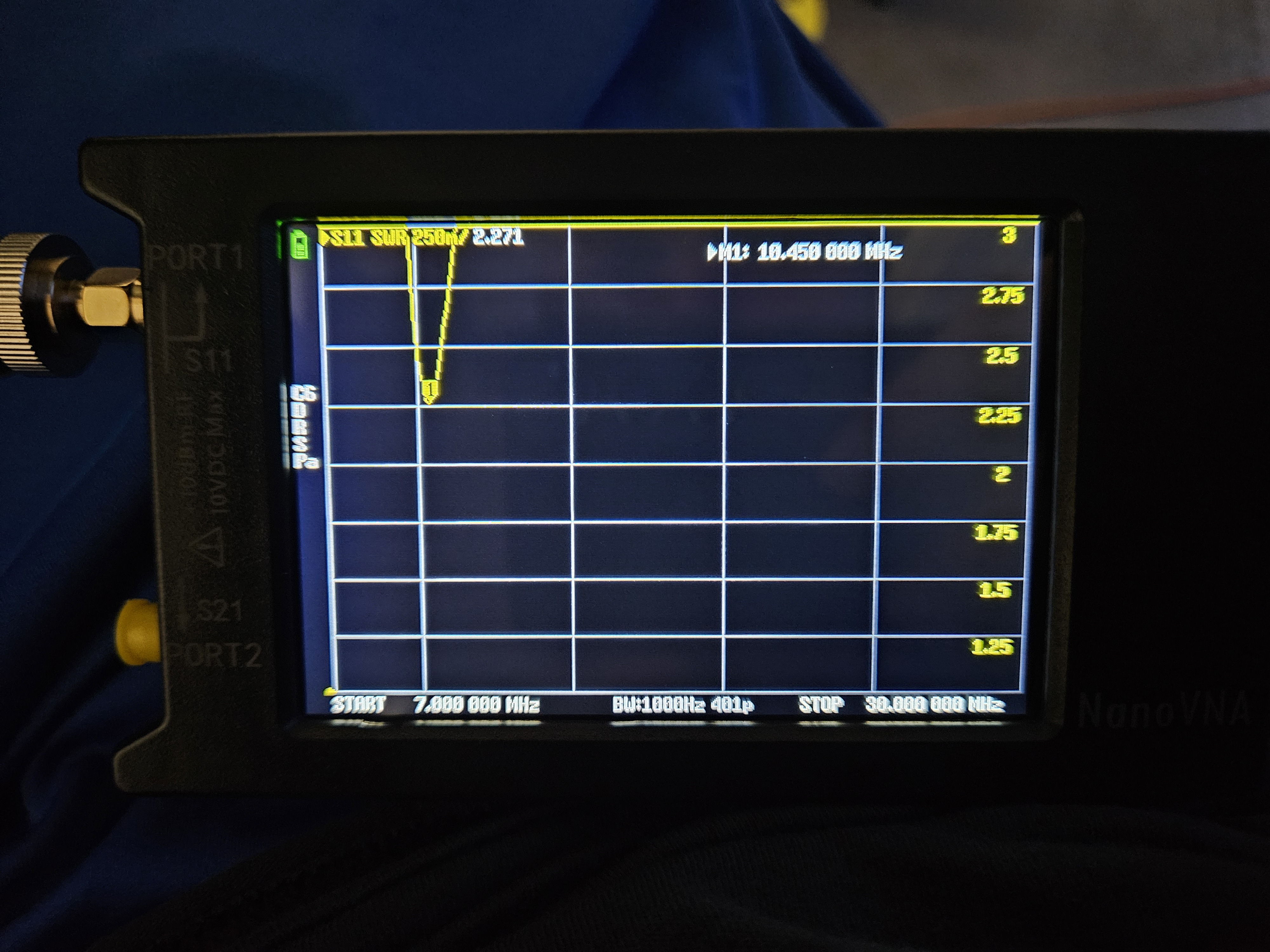
While I was able to get the faraday cloth working, I encountered a different issue. On the higher bands, my SWR curve wasn’t where I was expecting it to be. With the recommended 20 meter band whip length, the lowest point on the SWR curve was on a lower frequency than expected (around 10.45 MHz) and my SWR was above 2.25:1. However with the 40 meter loading coil attached, I was getting the results I expected, albeit having to shorten the whip slightly.
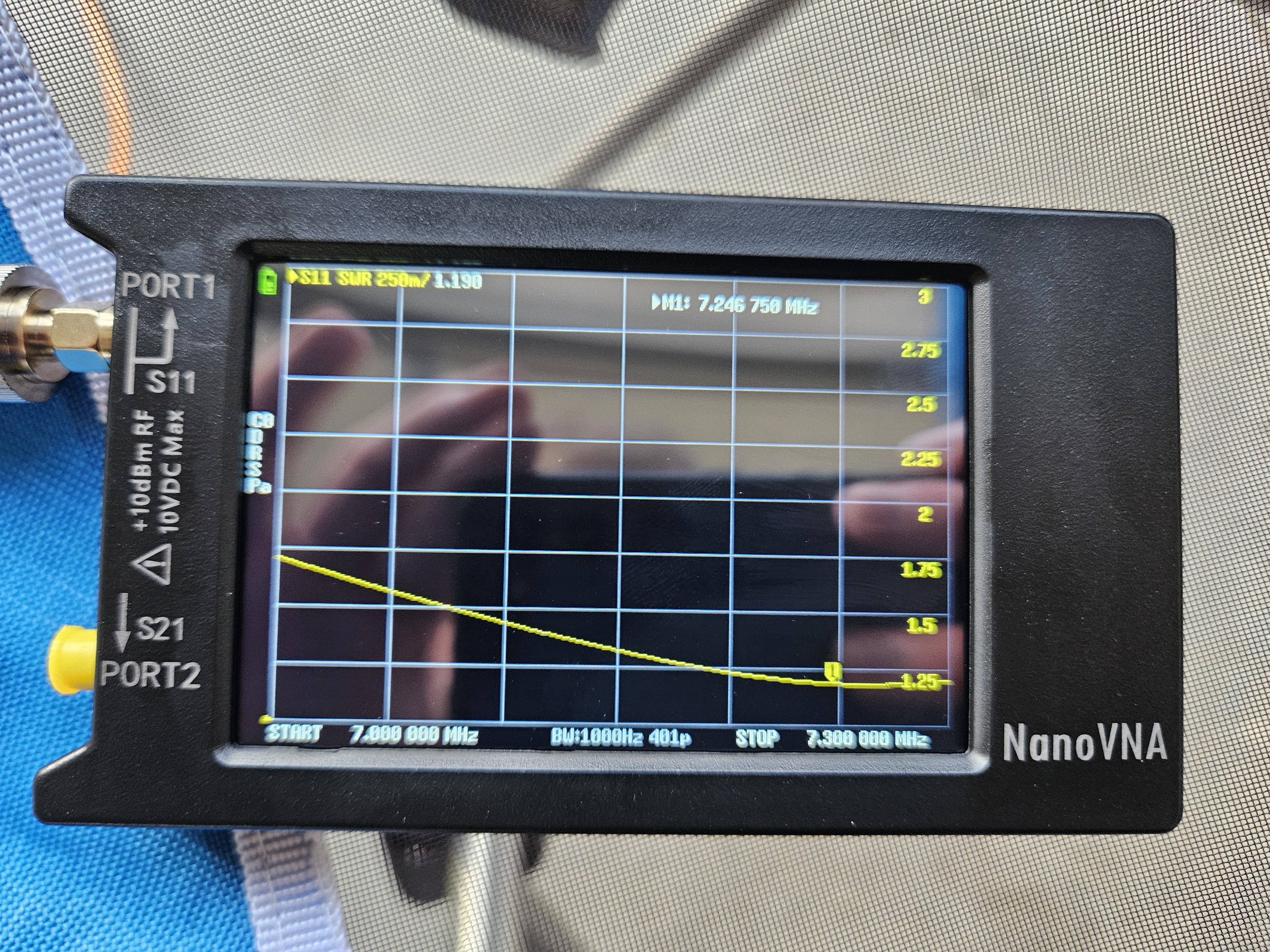
Even after shortening the whip, I was still getting SWR readings north of 2:1 on the voice portion of 20 meters. After some experimentation, it appears that the 6 foot test lead I was using to connect the feedpoint to the faraday cloth made the “length” of the ground plane too long, hence the lower frequency for the SWR dip. After I got home, I built a shorter jumper cable, and in limited testing I’m getting the expected results.
Contest Day
Even as late as Friday night, Saturday was looking to be rainy but the forecast shifted in my favor overnight. With that, I was gonna be jumping feet first into contesting with only two contacts in my log up to that point.
As the 2:00 PM start time approached, I got the antenna set up in the yard and the operating station (consisting of a folding table, a camp chair, and my laptop to connect to my Wavelog instance) in the garage. My operating conditions were less than ideal, since I was in an east-west valley and having compromised antenna and radials. In hindsight, I should’ve found some frequencies to call CQ instead of solely hunting and pouncing due to being one of the few West Virginia operators during the contest.
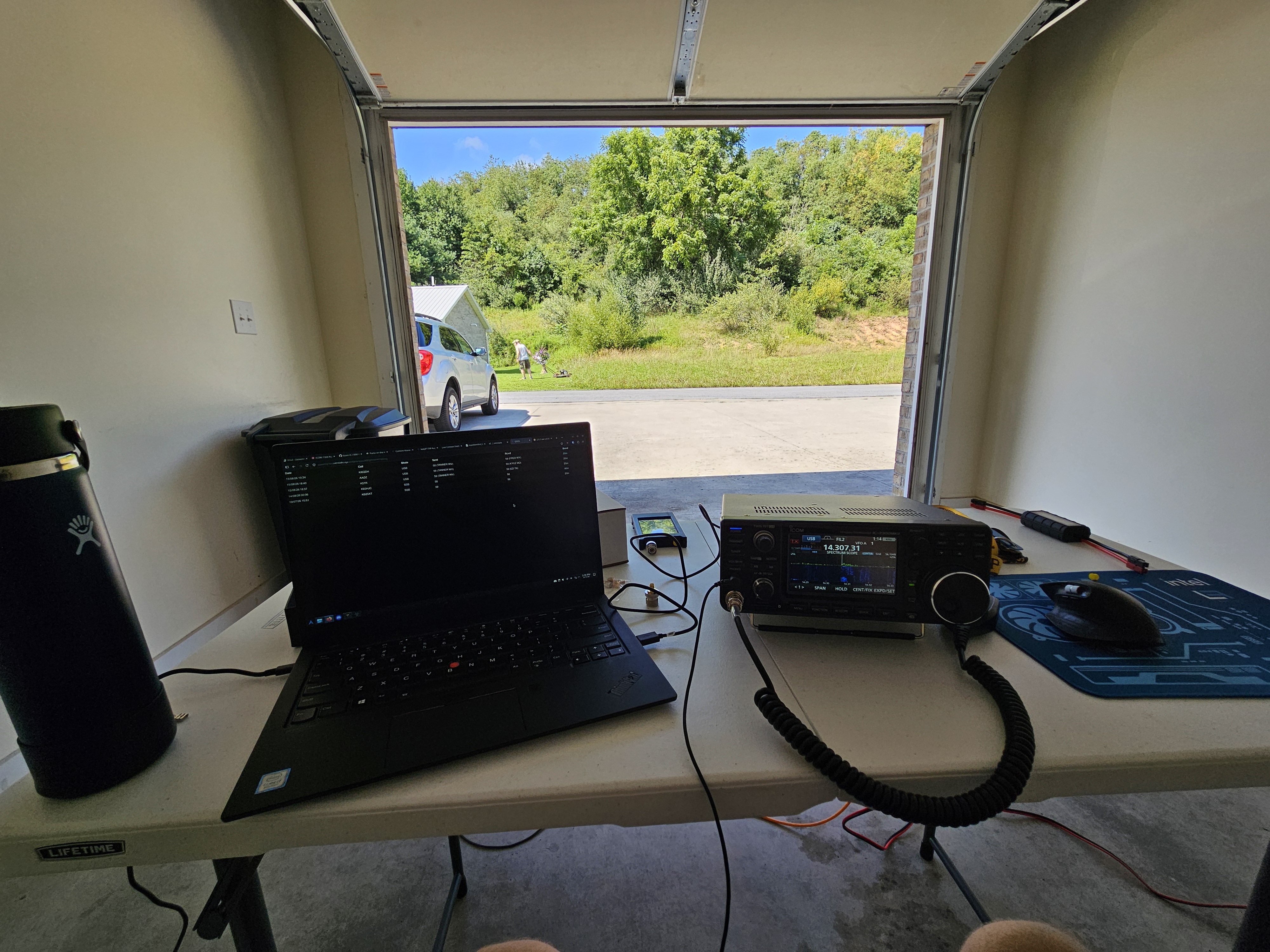
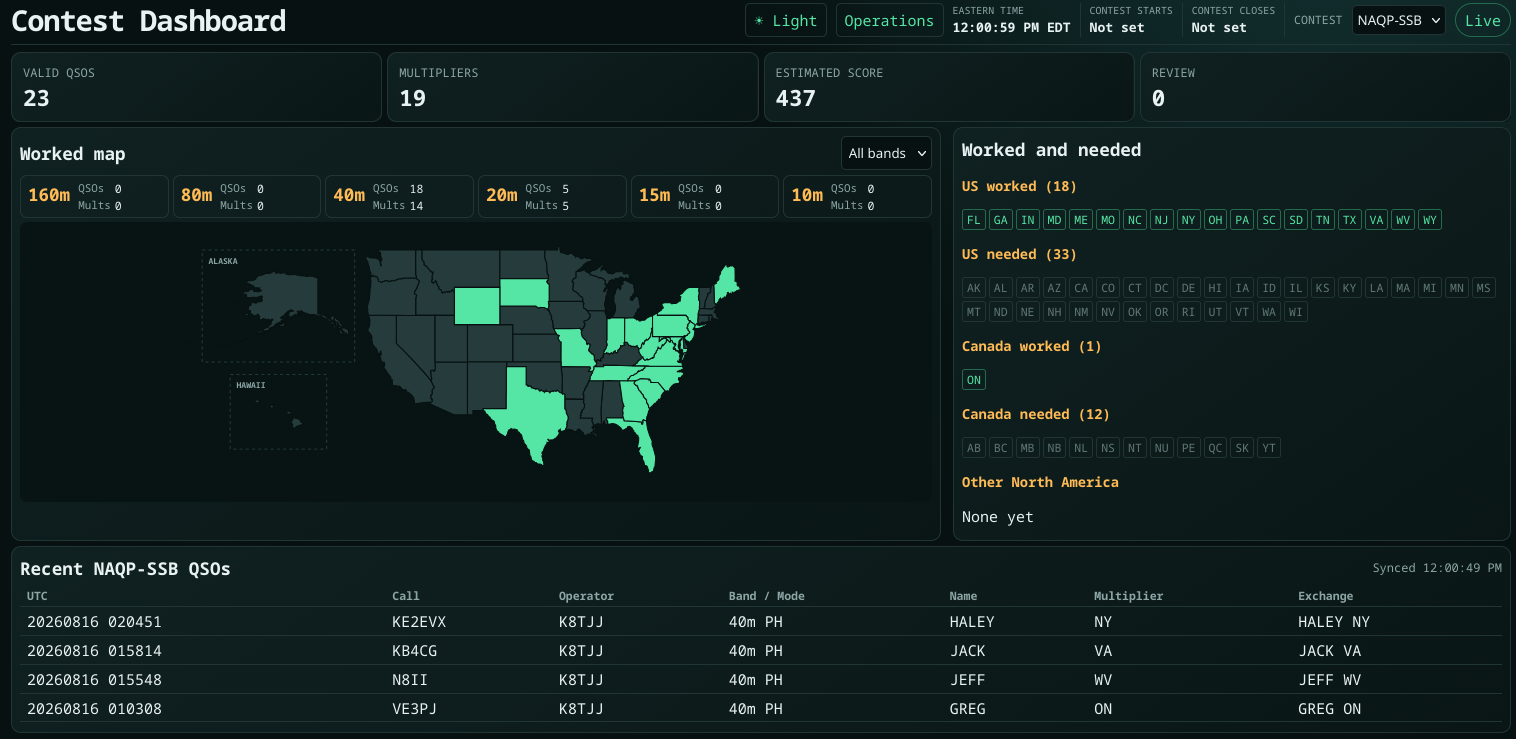
I still couldn’t get my SWR down on 20 meters but was still able to make five contacts into Maine, Missouri, South Dakota, Texas, and Wyoming. After about an hour and a half of struggling, I made the decision to switch to 40 meters since it was working better, and that was a good decision. In my first 45 minutes there, I was able to make more contacts on than I had in the entire time I was on 20 meters. I even managed to work my club’s station which was being operated by Justin (N0SYS) at the time.
Unfortunately, I had to take a three hour break just as I was building momentum due to thunderstorms moving into the area. After coming back around 8:00 PM, I was making additional contacts but not at the pace I was earlier in the afternoon. After around 10:00 PM, I just couldn’t seem to get out anymore and decided to call it quits a little after 11:00. Just before the end of the night, I made a vain attempt for a contact with the club station on 10 meters for an extra multiplier, with Thad (KD9YVI) at the helm.
My final total was 23 contacts with 19 multipliers (US states/Canadian provinces/other North American countries) for a total score of 437 points. I was hoping to do better but I’d say it wasn’t a bad result for someone using their HF radio for only the second time!
Now What?
With my limited footprint at home, I’ll primarily be operating portable, including some POTA activations in local state parks and recreation areas like Chain O’ Lakes near Albion or at Roush Lake down in Huntington. I also plan on getting more involved with my club and dabbling more in digital modes like FT8, and eventually learning CW. Since I like tinkering with things, I’ll probably also end up with a case of Gear Acquisition Syndrome by buying antenna and QRP radio kits down the line.
There’s a lot involved in ham radio, and one week isn’t nearly enough time to try out even a subset of what’s out there. I’m looking forward to getting more experience as an operator and being able to document that experience here.
Until then, 73.